FIFA Heroes: Soccer Action
- 4.2
- Rating
- 1.00M
- Installs
- Free
- Price

 Analysis by App-foxy
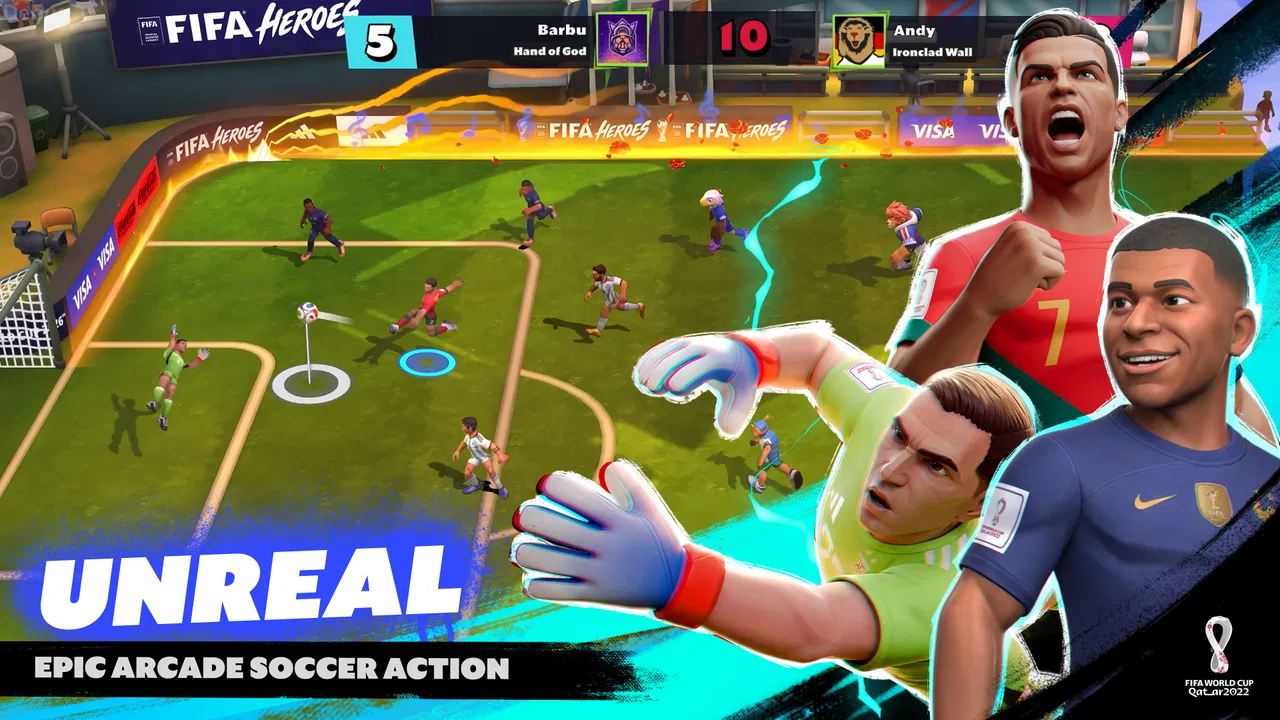
I spent time with FIFA Heroes: Soccer Action as a quick, competitive sports game rather than as a full football simulation, and that distinction matters from the first match. It is built around five-a-side arcade soccer, so the appeal is immediate movement, short bursts of action, and the satisfaction of creating a chance without needing to manage every detail of a traditional eleven-player match. I found it easiest to enjoy when I treated each game as a compact challenge instead of expecting the depth of a console football title.
The game comes from Solace Games & ENVER and is free to start. Its FIFA World Cup 2026™ official license gives the presentation a recognizable football identity, while the “FIFA Heroes” idea points toward a more character-focused take on the sport. It sits in the sports category and is suitable for Everyone, making it approachable for younger players and for anyone who wants something less demanding than a realistic football manager or simulation game.
What kept me interested was the speed of the basic loop. I could open the game, play a few minutes, and feel that I had done something meaningful even when the result was not a win. That is a strong fit for a bus ride, a short break, or the moment when I want competition without committing to a long session. The trade-off is that arcade action can feel less satisfying if I am looking for carefully built tactics, authentic match rhythm, or the broad control of a conventional football game.
You May Also Like

 Google Keep - Notes and lists
Google Keep’s Quiet Growth Shows the Appeal of Simpler Notes
As mobile work gets busier, Google Keep keeps winning a simple contest: capture a thought quickly, find it later, and get on with the day.

 Blood Strike: 2.5 Anniversary
Blood Strike’s Loadouts Turn Every Drop Into a Tactical Gamble
A close look at Blood Strike’s custom loadouts: how fast access to signature weapons reshapes its battle royale rhythm, rewards preparation, and narrows the gap between fights.

 Pandora - Music & Podcasts
Pandora’s Music Is Easy to Start, but Harder to Recover
Pandora’s strength is its low-effort path from a seed to a station. Its weak spot is how much confidence it asks you to place in connection, setup, and quiet recovery.

 8 Ball Pool
 Is Built on Rivalries, Rematches, and Routine
A close look at the rivalries, rematches, shared routines, and unanswered safety questions that turn a quick pool match into a persistent mobile community.

 Samsung Music
’s Quiet Strength Is Playing What You Already Own
Its reach comes less from spectacle than from dependable access to a personal library. That simplicity is both the app’s strongest retention engine and its ceiling.

 AccuWeather: Weather Radar
AccuWeather Review: A Quick, Clear Forecast for Everyday Decisions
For everyday plans, the best forecast is the one you can understand quickly. AccuWeather makes rain timing, radar, and local conditions easy to act on, with a few trade-offs.
More From Our News Desk



How the early matches create momentum
I found the opening matches most useful as a low-pressure way to learn how quickly a five-a-side game can turn: one loose move can become a counter before I have time to reset. That makes the early flow more than a warm-up; it gives me a practical feel for when to attack and when to protect space. The next section looks at how to keep that learning meaningful once the first rush settles.
Fast goals make the first sessions easy to understand
The strongest part of the opening experience is how quickly the game communicates its purpose. Five-a-side play naturally leaves less space between players, so the match feels active instead of slow. I was not waiting for long stretches before something happened. Possession, pressure, and the next scoring opportunity arrived quickly, which made the early matches feel welcoming even when I was still getting used to the controls.
That early accessibility is important because arcade sports games can become confusing when they throw too many systems at the player. Here, the most useful first goal is simply learning how to turn a small opening into a shot. I found that concentrating on positioning and timing was more productive than trying to force spectacular plays. A rushed attack often gave the other side an easy chance to respond, while a brief pause created a cleaner route toward goal.
For a new player, I would recommend using the first matches to learn the shape of the pitch rather than chasing a perfect score. In a small-sided game, every misplaced move is more visible. That makes mistakes useful: I could see whether I had advanced too far, left an opponent unmarked, or attacked without enough support. This is one of the less obvious strengths of the format. The compact field teaches basic arcade football habits faster than a crowded, more complicated simulation often does.
A short-session game with a clear everyday use
My most natural use case was playing several matches during a spare ten-minute window. I did not need to prepare a long career session or remember a complicated tactical plan from the previous day. I could return, play immediately, and stop after a small run of games. That makes the game particularly suitable for people who want a sports title that fits around daily routines rather than taking over the evening.
There is also a social advantage to the simple format. Someone who rarely plays football games can understand the objective quickly, while a more experienced player can focus on creating space and exploiting mistakes. I would be comfortable handing it to a friend who does not normally play mobile sports games because the five-a-side structure is easier to read than a full-pitch simulation with many simultaneous responsibilities.
Still, the quick format is not automatically ideal for everyone. Players who prefer a slow build-up, detailed player instructions, or long-term club management may find the opening matches too light. This is an action-first game, and its early goals are designed to get me moving rather than to reproduce the patient tempo of real football.
Progress signals that matter between matches
Between matches, I get more value from noticing a specific habit than from treating every unlock as proof of improvement. A small personal target—such as choosing a safer pass when the route forward closes—can make a short session feel purposeful without turning play into a checklist. That distinction matters when considering what progress actually adds to the experience.
Unlocks need to support play, not replace it
The most important question after the first few matches is whether progress feels connected to what I am doing on the pitch. In a game like this, unlocks are most satisfying when they give me a reason to try another match while still leaving the actual result dependent on my decisions. I paid attention to whether I was playing because I wanted to improve or merely because the next reward was waiting. That distinction shapes the long-term feel more than the licensed branding does.
I found the best approach was to treat progress as a secondary signal. Winning is enjoyable, but a close loss can still reveal something about my attack, defensive positioning, or timing. If I use each match to correct one specific mistake, the game has a healthier rhythm: play, notice a weakness, adjust, and return. That loop is more durable than simply repeating matches without changing my approach.
A practical tip is to set a small objective before starting. I might focus on avoiding reckless forward movement, creating one patient attack, or protecting a lead instead of trying to dominate every possession. This gives the match a purpose even when the reward path is not the main attraction. It also helps prevent the common arcade-sports problem where every game starts to feel identical because the player is only chasing the final score.
Where free access changes the feeling of progression
The game is free, but optional purchases range from $1.99 to $99.99 per item. That wide range is worth considering before getting invested in unlocks. I can begin without paying, which lowers the barrier for trying the game, but players who are sensitive to purchase prompts should decide early how much value they expect from the free route.
My advice is to play long enough to understand the basic match loop before spending anything. A purchase should solve a clear personal need, such as supporting a game I already enjoy, not be an impulsive response to a frustrating loss. In competitive arcade games, buying something does not automatically make the action more enjoyable; if the controls or match pace are not appealing at the start, an unlock is unlikely to change that fundamental reaction.
This is also where the game may suit some players better than others. Someone happy to sample a free sports title and progress at a relaxed pace can get a straightforward entry point. Someone who wants every meaningful option immediately, or who dislikes any pressure around optional spending, may prefer a paid game with a more predictable progression model.
The difficulty curve and the value of a close match
A close result is often more instructive than an easy win because it leaves me with a decision I can test next time, while a lopsided match can make the action feel less readable. I try to judge difficulty by whether I can identify a better choice, not just by the scoreboard. That perspective helps explain which players are likely to enjoy the challenge and which may prefer a gentler football game.
Challenge comes from decisions, not only speed
The compact five-a-side setup makes difficulty feel personal. When I lost, it was often tempting to blame the opponent’s pressure or the frantic pace, but the smaller team structure made my own choices easy to inspect. A poorly timed attack could leave too much room behind me. A hopeful pass could hand over possession. Because there are fewer players to hide behind, the game can make improvement feel direct.
That is a useful difficulty curve for beginners. I did not need to understand every possible football tactic to see why an attack had failed. The challenge grew from recognizing situations and responding more cleanly. I learned to value a safe reset when the route forward was blocked, and I became more careful about committing too many players to one side of the pitch.
One of my more useful discoveries was that chasing the next goal immediately is not always the best way to recover from conceding. The emotional pressure of arcade play encourages a rushed response, but a calmer possession can prevent the match from turning into a sequence of careless exchanges. This is the kind of small tactical habit that a basic store description would never explain, yet it makes a noticeable difference to how controlled the game feels.
Who will find the challenge satisfying?
I think the difficulty will appeal most to players who enjoy learning through repetition. The matches are short enough to retry without much frustration, and the small-sided format makes experimentation manageable. I could change one habit at a time and immediately see whether it helped. That creates a satisfying sense of personal improvement even when the overall progression is not the deepest part of the experience.
However, players who need a very gentle, almost automatic experience may find the competitive pressure tiring. Quick action is friendly at the start, but it can become demanding when every mistake produces an immediate counterattack. Likewise, simulation fans may not consider this a substitute for a more detailed football game. The challenge is about arcade reactions and compact decision-making, not the full range of responsibilities found in a realistic match.
For younger players, the Everyone rating makes the game broadly approachable, but I would still expect an adult to explain the idea of optional purchases before handing over a device. The age rating describes suitability, not whether the progression model will match every family’s preferences.
Retention pressure after the novelty fades
Once the novelty of quick goals wears off, I think the key question is whether the match itself still gives me a reason to return. Setting a stopping point and keeping purchases separate from the urge to recover a loss helps preserve the game as a brief, enjoyable break. The following section considers when that repeat-session appeal stays healthy and when it may start to feel like pressure.
Why the game can earn another session
The game’s best retention tool is the promise of a better next match. Because the action is compact, a disappointing result does not feel final. I can usually identify one decision I want to try differently, and that creates a natural reason to return. The licensed FIFA World Cup 2026™ setting also gives the game a recognizable identity, but the branding alone cannot carry repeated sessions; the on-pitch loop has to remain enjoyable.
I noticed that the strongest return moments came after near misses or close defeats. Those matches made me feel that improvement was within reach. A one-sided result was less motivating because it offered fewer useful decisions to analyze. This suggests that the game works best when I approach it as a series of small experiments rather than as a constant demand to win.
Another practical strategy is to stop after a good match instead of continuing until frustration takes over. The short-session design makes this easy. Ending on a satisfying result preserves the feeling that the game is a quick football break, while playing through repeated losses can make the same mechanics feel more repetitive than they really are.
When retention starts to feel like pressure
The free-to-play structure can change the tone if I begin measuring every session by what I have unlocked. The presence of item purchases, especially at the upper end of the listed range, means some players may feel tempted to accelerate their progress rather than enjoy the matches themselves. I prefer to keep the focus on gameplay and treat any purchase as optional support, because that keeps losses from feeling like a reason to spend.
This is also the point where the game may lose players who want a complete, self-contained sports package. If my ideal football game includes a deep league structure, extensive customization, or a long simulation campaign, the arcade five-a-side format will not replace it. I would choose a traditional football title for strategic depth and a dedicated multiplayer-focused alternative if my priority were a larger competitive ecosystem. I would choose this one when I wanted fast, readable action with a lighter commitment.
Before installing, I would ask myself three questions. Do I enjoy short arcade matches more than realistic football? Am I comfortable starting free and deciding later whether optional items are worthwhile? Can I accept that improvement may come from repeating compact situations rather than building a detailed club? If the answers are yes, the game has a clear place on a mobile device. If not, its licensed presentation may not compensate for the mismatch.
My verdict on the progression and overall fit
After playing it as both a casual time-filler and a more focused sports game, I see FIFA Heroes: Soccer Action as a good choice for players who want football reduced to its most immediate decisions. The five-a-side structure keeps the pitch readable, the goals arrive quickly, and the short matches make it easy to fit into ordinary routines. I especially liked how the format exposes my own mistakes instead of letting me hide behind a large team or a complicated tactical system.
The progression is most convincing when it gives me a reason to return without becoming the only reason to play. My strongest sessions came from setting a small tactical goal, testing it in a match, and learning from the result. That approach makes the game feel more substantial than its quick format suggests. It also protects the experience from becoming a simple reward chase, which is important in a free game with optional purchases.
There are clear limits. The action may feel repetitive to players who need broad variety, and fans of realistic football will find less tactical depth than in a full simulation. The purchase range also means I would approach spending carefully rather than assuming every unlock is necessary. Those are not minor details; they determine whether the game remains a pleasant pick-up-and-play title or becomes a source of pressure.
Technically, the current release is version 1.4.1 and requires Android 8.0 or later. Its audience is already substantial, with over a million installs, a 4.3 average from around fifteen thousand ratings, and roughly five hundred reviews. Those figures suggest that the concept has reached plenty of players, but my recommendation still comes down to fit rather than popularity.
My final recommendation is simple: try it if you want free, licensed, five-a-side arcade football that rewards quick decisions and short repeat sessions. I would recommend it to a friend who enjoys improving through compact matches and does not need a deep simulation. I would skip it in favor of a more traditional football game if realism, extensive management, or a purchase-free progression path matters more than immediate action.
FAQs for FIFA Heroes: Soccer Action
01What is FIFA Heroes: Soccer Action, and how does the gameplay work?
FIFA Heroes: Soccer Action is a fast-paced mobile soccer game focused on short matches, arcade-style controls, and special hero abilities rather than traditional full-length football simulation. You build a team of recognizable players and compete in quick offensive and defensive encounters. The controls are designed for touchscreens, making the game accessible, although mastering timing, positioning, and ability use still requires practice.
02Can FIFA Heroes: Soccer Action be played offline?
The game is primarily designed around online features, including competitive matches, progression systems, events, and team-related content. Some menus or training activities may remain accessible without a connection, but you should not expect the complete experience to work offline. A stable internet connection is recommended, especially when entering matches, synchronizing progress, or participating in live events.
03Is FIFA Heroes: Soccer Action free to download and play?
FIFA Heroes: Soccer Action can generally be downloaded without an upfront purchase, but it follows a free-to-play model. Progression may include rewards, upgrade systems, timers, optional purchases, and other monetized features. You can enjoy the core gameplay without spending money, but advancing faster or obtaining certain resources may be easier through in-app purchases, so parental controls may be useful.
04Does FIFA Heroes: Soccer Action require a powerful Android or iPhone?
The game is built for mobile devices and should run on many relatively recent Android phones and iPhones, but performance depends on your device’s processor, available memory, operating system, and storage space. Older or entry-level hardware may experience longer loading times, reduced visual quality, or occasional frame-rate drops. Checking the store’s compatibility requirements before installing is recommended.
05What should new players know about progression and team building?
New players should expect progression to involve collecting, improving, and strategically using different heroes or football characters. Team strength matters, but understanding each character’s role and ability can be just as important during matches. It is usually better to focus resources on a balanced lineup instead of upgrading everyone immediately. Regular events and daily rewards can also help free players develop their squads.
Pros
- Quick matches are well suited to short gaming sessions.
- Simple controls make it easy for newcomers to start playing.
- Hero abilities add variety beyond standard soccer mechanics.
- Bright visuals and lively animations give matches a polished feel.
- A broad roster encourages experimenting with different team setups.
Cons
- Progress can feel slower without regular play or extra spending.
- Matches may become repetitive once familiar strategies are mastered.
- Some abilities can make outcomes feel less dependent on soccer skill.
- Online competition may be frustrating against highly upgraded teams.
- The game may require a stable connection for several features.

FIFA Heroes: Soccer Action
Gallery